Every year, starting on the second Wednesday in January, Virginia lawmakers, advocates, and community members come together at the General Assembly Building in Richmond to form the State Budget and collaborate on hundreds of bills that impact communities across the Commonwealth.
Throughout this process, LAJC works diligently to elevate the voices of community members by working hand in hand with clients and community partners to champion policy changes that promote justice, equity, and opportunity for all Virginians.
Read on for information about what to expect during the General Assembly process and what bills LAJC is supporting during the current session. Follow us on social media (Instagram, Facebook) and subscribe to our emails for more information on how to get involved in advocacy opportunities like lobby days and public testimony.
Together, we can create meaningful policy change to dismantle systemic barriers and build a more just and inclusive Commonwealth.
LAJC’s 2026 Legislative Priorities
Housing
- Anti-Rent Gouging: Enables localities to protect tenants from abusive rent increases.
Worker Protections
- Heat Stress Protections: Requires employers to receive training and provide water, shade, and rest to prevent heat illness.
- Minimum Wage for Farmworkers and Temporary Workers: Ends exemptions that have historically excluded these workers from Virginia’s minimum wage law.
Immigrant Rights
- Protect Vulnerable Immigrant Youth: Expands access to Special Immigrant Juvenile (SIJ) status, a green card pathway for young people who have been abandoned, abused, or neglected by a parent, up to age 21.
- End State & Local Collaboration with ICE: Prevents the use of local resources for federal immigration enforcement.
Education
- Language Access for English Learners: Codifies federal guidance to ensure translation of vital documents and equal access to academic processes; see recent LAJC report, “Learning in Every Language: Guaranteeing Access and Opportunity for Virginia’s English Learners.”
- Safe Access and Privacy Protections at School: Strengthens privacy protections, prevents immigrant-based discrimination for students and families, and creates a required process for police arrests at public schools.
As part of the Fund Our Schools coalition, we are also advocating for bills that increase funding to school systems to ensure all students can access the education they deserve. You can read more about these efforts here.
Healthcare
- Privacy in Public Assistance Programs: Mandates public notice when agencies receive large-scale requests for personal data of applicants and recipients of public benefits.
Criminal Legal Reform
- Counsel at First Appearance: Guarantees representation before initial court hearings.
- Reduce Punitive Measures for Missed Court Dates: Eliminates felony failure-to-appear charges and limits misdemeanor penalties.
- Constitutional Fee Elimination for Court-Appointed Counsel: Ends the practice of passing on the fees for court-appointed counsel and a jury trial to indigent defendants.
- Judicial Discretion on Court Costs: Empowers judges to tailor court-imposed fees to an individual’s financial circumstances.
- Work Behind the Wall: Allows incarcerated workers to apply their earnings toward court debt.
- Pretrial Data Integration with Virginia Longitudinal Data System: Links existing pretrial data to statewide datasets—such as social services, education, and juvenile justice—to deepen understanding of Virginia’s pretrial system and support data-driven criminal justice solutions.
Youth Justice
- Minimum Age for Court Charges (Co-Led by RISE for Youth and Human Rights for Kids): Sets 11 as the minimum age for charging children in court.
- Juvenile Justice Oversight Shift (Led by RISE for Youth): Transfers oversight from Public Safety to Health & Human Resources.
- Parole Access for Youth (Led by RISE for Youth): Expands fair and meaningful parole opportunities for juvenile offenders.
- Judicial Review of Extended Detention (Priority of VCOY): Requires court approval for keeping youth beyond standard limits.
- Expanded Diversion Opportunities (Led by RISE for Youth and Priority of VCOY): Increases access to programs that divert youth from formal court processes.
Watch a presentation of our priorities in our FB live in both English and Spanish:
Tracking Bills
Easily track progress on bills throughout the General Assembly session here, using Fast Democracy. Bill information is added and updated frequently, so be sure to check back for updates.
About the General Assembly
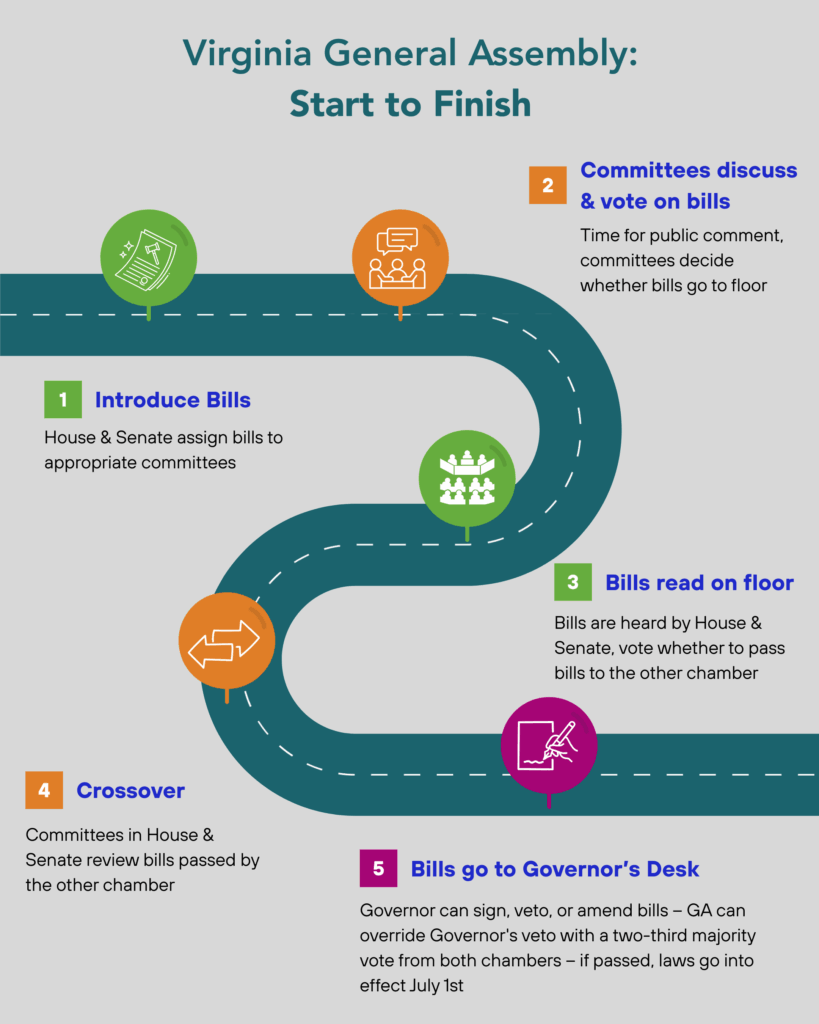
While there may be many changes along the way, here is a basic overview of the legislative process in Virginia:
Basic GA Terms & Definitions
Examples of common language in the Virginia General Assembly
General Assembly Session = also referred to as “session”; Virginia’s annual, 2-month-long legislative session that begins on the second Wednesday in January and brings together the House of Delegates and the Senate of Virginia in the Capitol building in Richmond, VA; on even years, session lasts for 60 days; on odd years, session last for 30-45 days; any session can be extended for a maximum of 30 days
House of Delegates = one of the two “chambers” in the General Assembly; consists of 100 members, each with a two-year term and annual salary of $17,640; the Speaker of the House is the presiding officer of the House and is elected by the House in even-numbered years for a two-year term
Senate of Virginia = one of the two “chambers” in the General Assembly; consists of 40 members, each with a four-year term and annual salary of $18,000; the Lieutenant Governor is the presiding officer of the Senate and is elected in a statewide election for a four-year term
General Assembly Building (GAB) = where General Assembly member and staff offices and committee rooms are located and where session convenes; open to the public and connected to the Capitol building by tunnel
Committee = a group of legislators from the Senate or the House of Delegates organized for the purpose of considering and decision on bills in front of the General Assembly; this is the first place a bill is considered in its path to become a law.
Subcommittee = a smaller group of legislators from the Senate or the House of Delegates of the larger standing committee; considers specific categories of bills and makes recommendations to the full committee
Patron = a bill sponsor; a legislator in the Virginia House of Delegate and Senate of Virginia who introduces bills and budget amendments
HB = House Bill
SB = Senate Bill
Crossover = the General Assembly’s deadline for bills to pass out of their chamber of origin to be considered by the other chamber. From this point forward, the House may only consider bills passed by the Senate and the Senate can only consider bills passed by the House.
Sin die = pronounced “sigh-nee dye”; the end of the legislative session; after this, bills are sent to the Governor’s desk to either be amended, signed into law, or vetoed
Veto = an executive power of the Governor to stop a bill from going into law, effectively killing it for that year
More Information
Use these resources to learn more about the legislative process, who your representatives are, and how to get involved in advocacy opportunities: